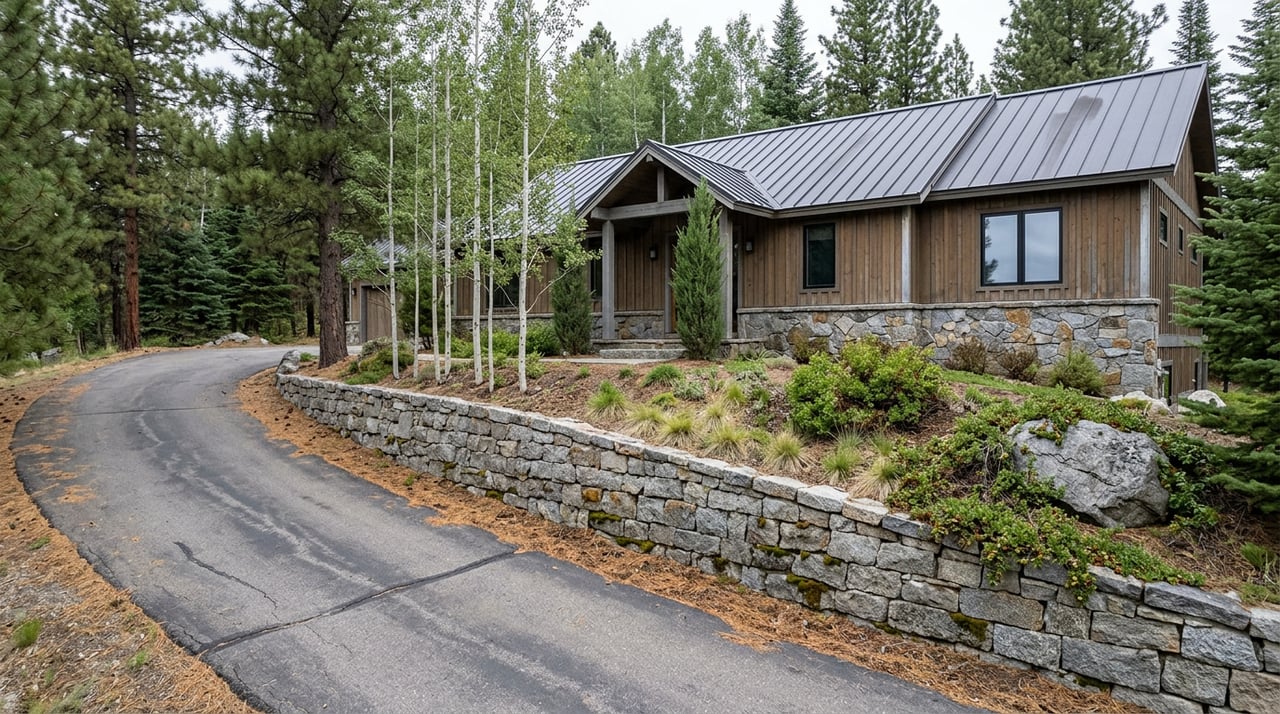
Two homes in Bailey can carry nearly the same asking price, sit within a couple of miles of each other, and answer a completely different question every time it snows: who actually shows up to clear the road. One sits on a stretch that Park County itself doesn't promise to plow. Another sits inside a special district with legal authority to tax for road work. A third sits on a private road funded by a homeowners association that can vote to raise dues or let the gravel go soft for another season. None of that shows up in the listing photos. None of it shows up in the price.
If you've already checked what homes in Bailey and Pine are asking this year, you've done the easy part. The number on the listing is the smallest piece of information you need before you write an offer up here.
Park County Says the Quiet Part Out Loud
Most buyers assume a public road means a maintained road. Park County's own Development Guidelines page corrects that assumption in plain language: county roads in more remote areas may be graded only once each year, if at all, and residency is not a factor in maintenance or snow removal priority. Main thoroughfares, mail routes, and school bus routes get cleared first. Everything below that tier gets a courtesy pass, not a guarantee.
That distinction matters most on the Bailey side of the neighborhood, where Park County is the governing authority and a large share of the housing stock sits on roads below that top tier. A driveway that looks identical to its neighbor's on a June afternoon can behave completely differently in February, and the county has already told you, in writing, that owning the house doesn't change the order you get plowed in.
Four Roads, Four Rulebooks
The word "Bailey" covers several legally distinct ways a road gets maintained, and a buyer touring three listings in a single afternoon can cross all four without realizing it.
- County-maintained, no service guarantee. This is the default for many rural Park County roads, and it's the category the guidance above describes. Public ownership does not equal a plowing schedule.
- HOA-funded private roads. Some Bailey subdivisions along Highway 285 fund grading and snowplowing through voluntary association dues, with the scope of service set by whatever the board approves each year. One well-known example maintains a community park with a pavilion, playground, and a trail to the summit of Mt. Bailey, which says more about the strength of its amenity budget than about how often the road itself gets bladed.
- Metropolitan district roads. Harris Park Metropolitan District, formed in 1960 under the Colorado Special District Act, is a taxing entity, not an HOA, and its own governing documents draw that line explicitly. The district's frequently asked questions page also states plainly that some public roads inside its boundaries are not maintained by anyone at all, county or district.
- Privately negotiated access. Other Bailey and Pine parcels rely on shared easements or road agreements that were never accepted for public maintenance and were never formalized under an HOA or district either. Here, the obligation lives in the deed and the covenant, not in any office you can call.
Four categories, one town name, and that's before accounting for the fact that Pine and Bailey sit in two different counties entirely. Pine falls under Jefferson County. Bailey falls under Park County. Different road departments, different septic authorities, different offices to call. The subdivision plat and the recorded covenants tell you which rulebook a given parcel is under. The listing sheet does not.
The Median Price Is an Average of Very Different Roads
Look up Bailey's home values across a couple of sources this year and you'll get numbers that don't agree with each other. One national aggregator put the median list price at $570,000 as of June 2026. Around the same time, a separate home-value model put the typical Bailey home closer to $545,719, a figure that tool showed down roughly 3 percent over the prior year.
That gap isn't a data error. It's what happens when a single town name gets used to describe homes sitting on four different road systems, at four different price points, with four different sets of buyer expectations about winter access. A median is built to smooth over exactly this kind of variation, which is precisely why it can't tell you what you actually need to know about one specific address. The number is useful for sizing up the market. It's the wrong tool for evaluating a single house.
The Same Patchwork Runs Underground
Roads aren't the only place this shows up. On the Bailey side, Park County requires a septic inspection at the time a property changes hands, under the county's onsite wastewater treatment system regulations, and that inspection has to be resolved before the title can transfer. Skip it, and the deal can stall at the title company, not at the negotiating table. Pine sits under Jefferson County's own septic permitting program instead, with its own inspection and maintenance requirements, so a buyer working across both communities is really working with two separate systems that happen to share a highway.
Wells carry their own version of the same layering. A permit marked "household use only" allows indoor plumbing and nothing else, no garden hose, no stock tank, no extra irrigation. A domestic-and-livestock permit allows broader outdoor use, but it's generally tied to larger parcels that aren't in an over-appropriated basin, and many smaller lots need a separate court-approved augmentation plan before the well can be used the way a buyer assumes it can. None of this is visible from the yard. All of it is recorded somewhere, and none of it is optional to check.
Before You Write the Offer
The pattern across roads, septic, and wells is the same: Bailey and Pine don't run on one set of rules, they run on whichever rule attaches to that specific parcel. A few steps handle most of it.
- Pull the recorded plat and covenants, and read Schedule B on the title commitment for any road maintenance obligation or easement language.
- Call the county road department for that specific address, Park County Road and Bridge on the Bailey side or Jefferson County's road and bridge division on the Pine side, to find out whether the road is county-maintained and where it sits in the priority order.
- If an HOA or metropolitan district is involved, ask for the last two budget cycles covering road grading and snow removal, and how dues or mill levies have moved.
- Confirm whether the property's septic system already has a current transfer-of-title inspection on file, or whether the seller still needs to schedule one.
- Verify the well's permitted use category and whether an augmentation plan is required before you count on outdoor water use.
None of these questions are dramatic on their own. Skipped together, they're how a buyer ends up owning a beautiful house on a road nobody is contractually required to plow.
We've walked through this same private-road-versus-HOA distinction for buyers looking at Conifer, and the underlying lesson holds here too: in mountain Colorado, the governance attached to the road matters as much as the house sitting on it.
If you're comparing properties in Pine and Bailey and want someone who already knows which roads fall into which category before you fall in love with a listing, Alicia Sexton has spent years working these exact subdivisions. Let's Connect and go through the specific parcel you're considering, road status and all, before you write an offer.